
Class IV Therapy Laser: A Buyer Safety Checklist
A practical Class IV therapy laser buying checklist covering clinical use, specifications, eye safety, training, service, and handover.
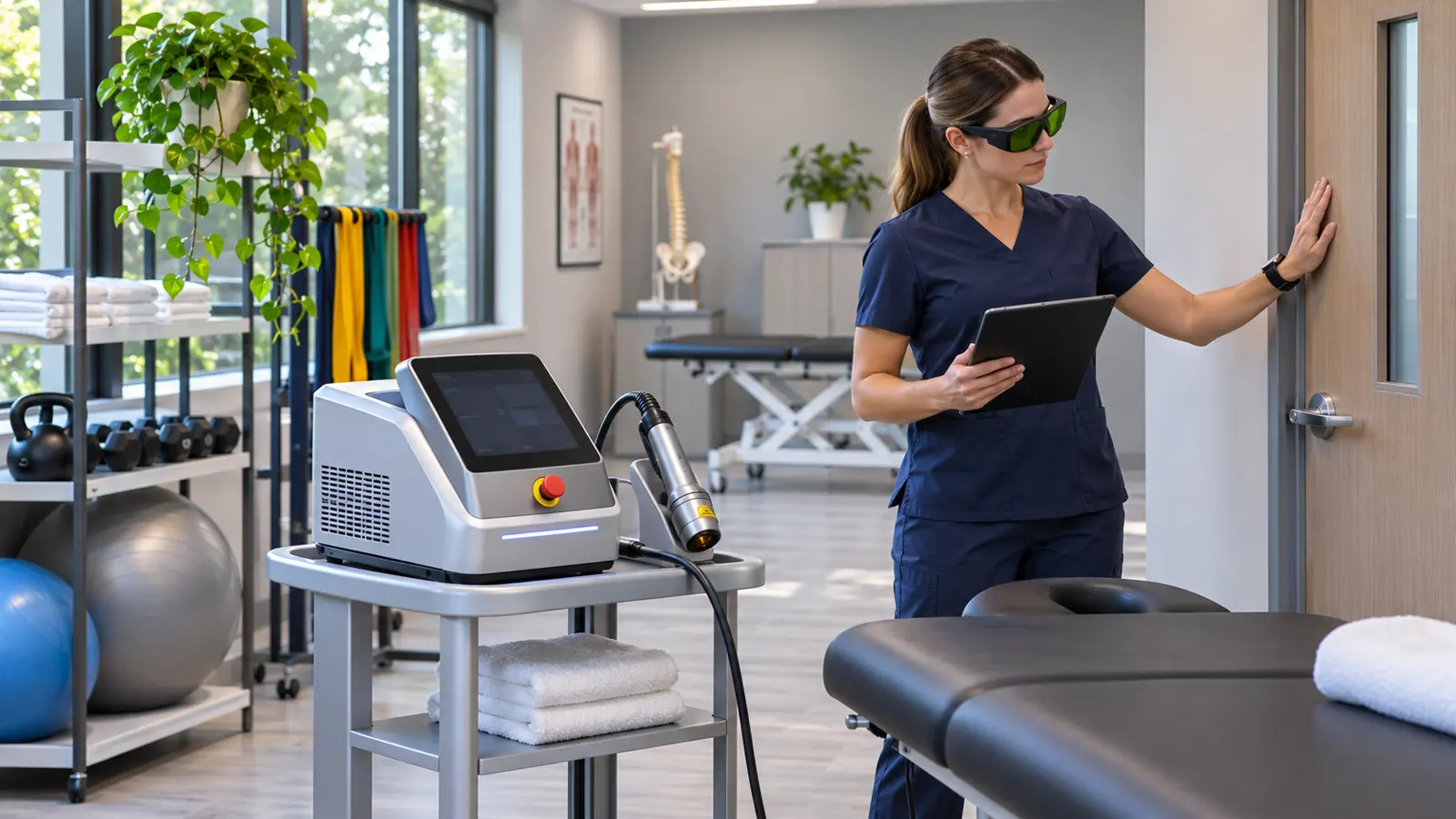
A Class IV therapeutic laser can look like a straightforward addition to a rehabilitation or wellness practice. Product pages often highlight power, treatment speed, and versatility. Yet a purchase decision needs more than a wattage figure. A Class IV laser can present eye, skin, and fire hazards if the device, room, protective eyewear, and operator training are mismatched. Clinical claims also need to fit the device's intended use and available evidence.
This buyer guide explains the questions to ask before procuring a Class IV therapy laser, how to compare specifications, and what a responsible handover should include. It is written for decision makers, not as a treatment protocol. You can review the Regenis Class IV laser product alongside the broader equipment catalog. Confirm current specifications and availability directly before ordering.
What does Class IV mean?
Laser classes describe potential hazards under specified conditions. A Class IV laser is a high-hazard category: direct or scattered beams may injure eyes or skin, and some applications can create a fire risk. The US FDA laser safety overview explains laser classes and the importance of avoiding exposure. The class is a safety classification, not proof that a device produces better clinical outcomes than another option.
Therapeutic products can differ in wavelength, output, beam delivery, modes, software, applicators, and intended use. Two devices labelled Class IV may therefore have very different workflows. Ask the supplier for a current technical data sheet, model identification, instructions for use, and documentation relevant to sale and use in your location. Marketing language should not be a substitute for these documents.
Begin with the clinical use case
Write down what services your team expects to offer, which professionals will operate the device, and which patient groups are within the intended use. Check whether the product's labeling supports those applications. If a sales presentation claims the laser treats many unrelated conditions, ask for the evidence and permitted indication for each. Do not assume a device will fit every musculoskeletal or skin complaint.
Treatment decisions belong to qualified clinicians who can evaluate the patient and choose appropriate care. A device may be one part of a programme involving exercise, rehabilitation, medication, or other approaches. Avoid promising cures, guaranteed pain relief, or a fixed number of sessions. The practice should have a way to explain uncertainty and alternatives to patients.
Read the wavelength and power specifications carefully
Wavelength affects how light interacts with tissue and what protective eyewear is required. Output power and energy settings influence the exposure delivered, but a bigger maximum number is not automatically better. Ask whether the stated power is continuous, peak, or combined across multiple emitters. Check the range of adjustable settings and whether the machine records delivered parameters.
Review spot size, beam profile, handpiece design, distance requirements, and contact or non-contact use. These details influence operator technique and safety. If a supplier compares only the headline wattage with a competitor, request a complete specification table. Ask the clinical trainer to explain how protocols are selected, documented, and changed when a patient does not respond or experiences discomfort.
Eyewear must match the device
Protective glasses are not interchangeable. They need the appropriate wavelength range and optical density for the laser and exposure conditions. Ask for the eyewear specification in writing and verify that every person who could be in the controlled treatment area has suitable protection. Ordinary sunglasses are not laser safety glasses. A pair supplied in the box should not be assumed adequate without checking its markings and documentation.
The room may need controlled access, warning signs, suitable surfaces, and a policy for reflective objects. Staff should know when the laser is armed, who may enter, and how to stop an exposure. The OSHA laser hazards overview outlines practical hazards, although local requirements must be checked in India. Your supplier should help translate device-specific instructions into a workable room setup.
Ask about interlocks and emergency controls
Check whether the system has a key switch, emergency stop, emission indicator, interlock capability, and other controls specified by the manufacturer. Ask the supplier to demonstrate each control and explain failure modes. The operator should know what happens after a power interruption and how to ensure the device cannot emit unexpectedly when a handpiece is set down.
Request written cleaning and maintenance instructions, as contamination or damaged optics can change performance and safety. A service plan should identify who can inspect the device, how faults are reported, and whether treatment must stop during a fault. Our equipment downtime planning guide covers how to prepare for service interruption across devices.
Training is part of the purchase
Ask who provides initial training, what topics it covers, whether new staff can be trained later, and how competence is documented. Training should include indications and contraindications, eye protection, room control, patient screening, parameter selection, cleaning, incident response, and record keeping. A short sales demonstration is not a competency assessment.
Keep training records for every operator and update them after changes to the device or protocols. Our medical device training records checklist gives a simple documentation framework. Appoint someone responsible for checking that eyewear and safety procedures remain available months after installation, when the original demonstration is no longer fresh in everyone's mind.
Ask how claims are supported
Suppliers may cite published studies, but a study of one wavelength, dose, or condition may not apply to a different product or treatment claim. Ask for evidence that matches the model and intended use as closely as possible. Check whether outcomes are clinically meaningful, whether the study has a comparator, and whether adverse effects were reported. A testimonial is not evidence of effectiveness.
When patient education is written, describe what is known and what remains uncertain. Avoid claims that a device “regenerates” tissue or replaces established care unless robust evidence supports that specific statement. Consistent, accurate language protects patients and helps clinicians set realistic expectations. A buyer should assess the scientific case and the safety case separately.
Compare the full cost of ownership
The purchase invoice is only one component of operating a device. Ask what is included in the warranty, what routine servicing is required, how replacement parts are obtained, whether software updates cost extra, and how long the device may be unavailable during repair. Also consider training, room preparation, suitable eyewear, consumables if any, and staff time. Request these details in writing rather than assuming they are part of the quoted package.
Cost planning is not a reason to compromise on eye protection or training. A cheaper device with poor support may cause avoidable downtime, while an expensive device is not automatically the right clinical choice. Compare suppliers against the same checklist and your actual service demand. This article does not give or promise exact prices; ask vendors for current itemized terms.
What to inspect at installation
Confirm model and serial number, all supplied accessories, eyewear markings, technical documents, warranty, and service contacts. Have the supplier demonstrate normal start-up, controls, shutdown, emergency stop, and a safe handover workflow. Record installation date and training attendance. Test the device only according to the manufacturer's instructions, in a controlled area with appropriate protective measures.
Do not begin patient use while staff are unclear about contraindications or emergency response. Ask the supplier to resolve gaps before signing off the handover. A clear acceptance checklist creates a shared record of what was delivered and what remains outstanding. It also helps future staff know which documentation applies to the device on site.
Patient screening and records
The operator should confirm the patient's clinical assessment, intended treatment area, relevant contraindications, and consent according to the device instructions and professional standards. Eye protection is required for the patient as specified. Record the settings, site treated, session duration, response, and any adverse event. The exact form may vary, but the record should allow another qualified clinician to understand what happened.
If a patient reports unexpected pain, skin change, visual symptom, or another concerning effect, stop treatment and follow the incident plan. Do not continue because a sales protocol says a particular number of sessions is standard. Patient response and safety take priority over a preset package. Report suspected device faults through the appropriate supplier and local reporting route.
A simple comparison worksheet
For each shortlisted model, record intended use, wavelength or wavelengths, continuous and peak power, adjustable range, spot size, delivery modes, eyewear specification, interlocks, software, training, service response, warranty, and documentation. Then ask a clinician to assess evidence for the intended indications and a responsible safety lead to assess room and operator requirements.
This process helps avoid buying based on one prominent specification. If two devices appear similar, the deciding factor may be training quality, clear labeling, repair access, or fit with the team's existing workflow. A product that cannot be operated consistently and safely is a poor purchase even if its brochure is impressive.
Frequently asked questions
Is Class IV automatically more effective?
No. Class IV describes a hazard category, not a clinical effectiveness ranking. Outcomes depend on the condition, protocol, device characteristics, and quality of evidence.
Can ordinary sunglasses be used for protection?
No. Laser eyewear must be specified for the device's wavelength and exposure conditions. Check the manufacturer's instructions and eyewear markings.
Do all Class IV lasers use the same protocol?
No. Devices differ in wavelength, output, beam delivery, and intended use. Protocols must match the specific product and the clinician's assessment.
What training should the supplier provide?
Expect device operation, safety controls, eyewear, room setup, clinical indications and contraindications, cleaning, records, maintenance, and incident response. Document competence for each operator.
Can a laser replace rehabilitation exercises?
It should not be presented as a universal replacement. A clinician should choose an evidence-based plan for the patient's condition, which may include exercise and other care.
What should be checked before the first patient?
Verify installation, documentation, correct eyewear, room controls, trained operators, emergency procedures, and a clinical protocol that fits the device's intended use.