
Clinical Body Composition Analyzer vs Smart Scale
Clinical body composition analyzer or smart scale? Compare validation, repeatability, workflow and service before choosing equipment.
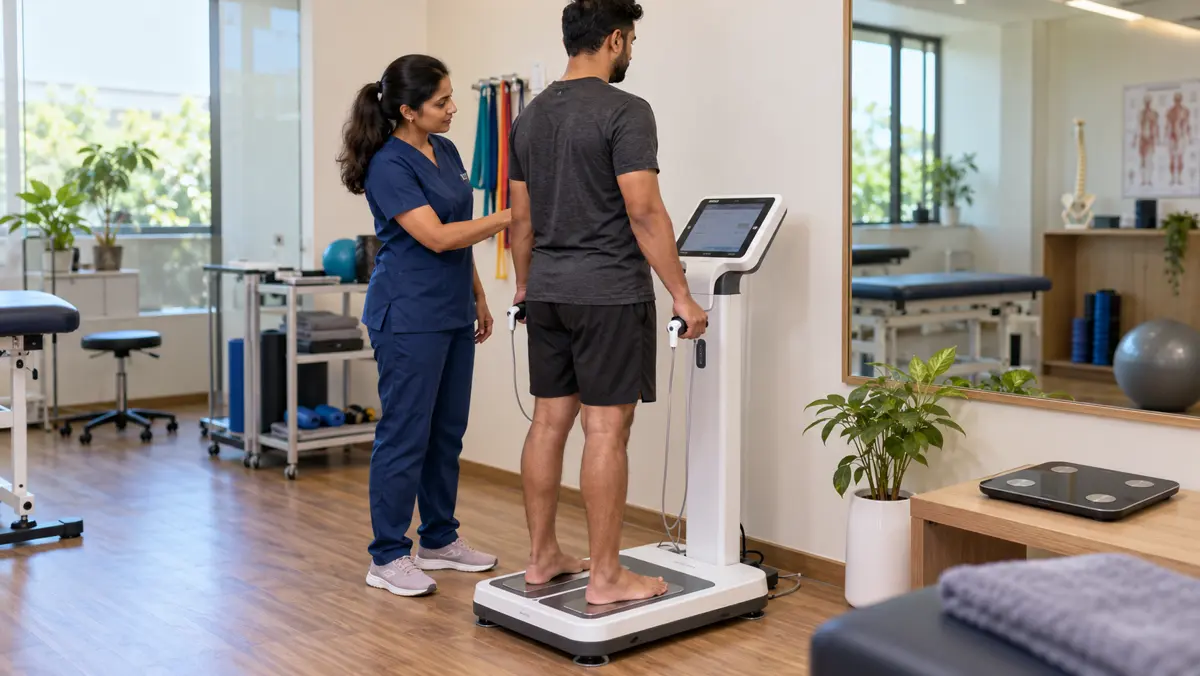
A bathroom smart scale can estimate body fat percentage in seconds. A professional body composition analyzer may also display fat mass, lean mass, segmental values, and other outputs. The two devices can look surprisingly similar to a patient, which leads to an important procurement question for rehabilitation centres, wellness programmes, and metabolic-care teams: what makes a device suitable for clinical workflow rather than home curiosity?
The answer is not simply price, the number of charts on screen, or a claim of medical grade accuracy. Device validation, measurement method, patient preparation, repeatability, intended use, data governance, service support, and how clinicians interpret the results all matter. This guide explains the questions a facility should ask before selecting a body composition analyzer and where even an advanced device has limits.
What most smart scales actually measure
Many consumer scales use bioelectrical impedance analysis, often shortened to BIA. A small electrical signal passes through the body and the device measures resistance. Software then estimates body water and derives fat-free mass and fat mass using equations. Different models may use foot-to-foot, hand-to-hand, or multiple electrode pathways. Some add several frequencies or segmental measurements.
That means a displayed body fat percentage is an estimate, not a direct observation of fat tissue. Algorithms may assume particular body proportions and hydration patterns. A simple scale may be useful for a consistent personal trend, but a number with one decimal place should not be mistaken for laboratory precision. Research on BIA has highlighted limitations when fluid balance or body geometry differs from the populations used to build the equations. See this clinical review of BIA validity for the underlying cautions.
What a clinical workflow needs beyond a number
In a clinic or rehabilitation setting, the output becomes part of an assessment and may influence follow-up. The team must know what the device measures, what it estimates, how reliable repeated readings are, and which patients require extra caution. The operator should be able to explain why one reading changed and whether the change could reflect hydration rather than actual muscle or fat change.
For example, a patient assessed after exercise, a heavy meal, a long journey, or a period of illness may have different body water than at a previous visit. The machine can produce a precise-looking printout while the conditions are not comparable. Good workflow therefore starts before a person steps onto the platform: consistent timing, clear preparation instructions, and documentation of relevant conditions.
Ask for validation, not just a brochure claim
Vendors may compare their device with DEXA or another reference method. Ask to see the study, the population tested, the number of participants, and the range of body sizes and ages. Was performance assessed in the type of patients your centre serves, or only healthy young adults? Was the comparison based on averages across a group, or does it show acceptable error for individual decisions?
A 2026 expert-endorsed methodological guide describes standards and limitations across bioimpedance, DEXA, CT, and ultrasound approaches. No method is perfect for every purpose. If a vendor describes a device as "equivalent to DEXA," ask what that statement means in practice and whether the evidence supports it. Clinical-grade should describe documented suitability for a defined use, not merely a premium finish.
Compare repeatability under your own conditions
Before procurement, run a small in-house assessment with staff or volunteers. Measure the same person more than once under controlled conditions, following the vendor's instructions. Look at the spread of results, not just whether the screen produces a report. Then repeat on another day under comparable conditions. The device should behave consistently enough for the decisions you intend to make.
Ask how the unit handles footwear, clothing, jewellery, implanted devices, pregnancy, mobility limitations, and people who cannot stand steadily. These situations can affect both safety and data quality. Your clinical team should define exclusion or alternative-assessment pathways before launch, rather than discovering them after patients begin booking.
Understand segmental analysis and lean-mass claims
Segmental reports can be useful for discussion, but they are still estimates derived from device measurements and assumptions. A display suggesting that one arm has gained a precise amount of muscle after a short rehabilitation interval may overstate certainty. Fluid shifts, timing, electrode contact, and algorithmic changes can influence the result.
For rehabilitation decisions, body composition should be considered alongside strength, mobility, performance, symptoms, and clinical history. A device cannot replace a functional assessment. Regenis has separate guides to force plate versus isokinetic testing and isokinetic strength symmetry, which address different questions from body composition.
Check reporting, integration, and data ownership
Clinical equipment is also a software purchase. Ask whether reports can be exported in a usable format, whether measurements can be compared over time, and how patient identifiers are handled. Who can access the data? Is it stored locally or in a cloud service? What happens if the subscription ends or the device is replaced? Are backups and audit trails available?
A polished report helps patients understand a plan, but it should not encourage overconfident interpretations. Your staff need a standard explanation of what a change likely means and what it does not prove. The report should support a conversation rather than act as a diagnosis. If your practice sees patients with metabolic disease, consider how a body composition result fits with laboratory markers and functional measures.
Service, calibration, and training matter
Ask the supplier how installation, operator training, maintenance, software updates, and repairs are handled in your city. Understand what checks are recommended between formal service visits. A device that produces excellent specifications but cannot be supported promptly may be a poor fit for a high-throughput facility.
Training should cover both operation and interpretation. Staff should know when not to measure, how to standardise conditions, and how to explain uncertainty. Managers should know the expected turnaround for parts and whether a loaner unit is available during repairs. These details often determine whether equipment remains useful after the initial launch. Regenis's body composition analyzer buying guide offers a broader procurement checklist.
A practical comparison checklist
When comparing a professional analyzer with a smart scale, document the intended clinical use, measurement method, published validation, population limits, repeatability, preparation protocol, patient safety notes, reporting features, data ownership, and local support. Ask the vendor to demonstrate the device with your staff and show a sample patient workflow, not only a marketing screen.
If your goal is a broad wellness trend for healthy adults, a simpler device may be sufficient. If decisions depend on small changes in lean mass, segmental estimates, or repeated clinical follow-up, the validation and workflow standards must be more demanding. There is no universal device that is best for every facility. The right purchase is the one that produces interpretable data for the people you actually assess.
Frequently asked questions
Is a clinical body composition analyzer always more accurate than a smart scale?
Not automatically. Some professional systems offer better validation and control, but accuracy depends on the model, population, preparation, and question being asked. Ask for evidence for the intended use.
Can BIA measure muscle directly?
No. BIA measures electrical properties and estimates body compartments through equations. Lean mass is not identical to skeletal muscle, and hydration can influence the estimate.
Why do body fat percentages change after exercise?
Exercise can change fluid distribution and skin conditions. This can affect impedance measurements even when body fat has not changed meaningfully. Standardise timing and preparation for comparisons.
Is DEXA required for every patient?
No. DEXA can answer some questions more directly, but access, cost, radiation exposure, and clinical purpose all matter. Choose the method that fits the decision and know its limits.
Should a rehabilitation centre use body composition as a success metric?
It can be one supporting measure, but function, strength, mobility, symptoms, and patient goals often matter more. Do not let a single percentage replace clinical assessment.
What should we request in a supplier demonstration?
Request a full measurement workflow, repeat readings, report export, cleaning and safety instructions, training plan, local support details, and evidence for the device's claims.
Sources and procurement note
The discussion of measurement limits draws on a review of BIA validity and a 2026 methodological standards guide. This article is general procurement education, not an endorsement of a specific model or a substitute for clinical validation.